

Som Defensores will deploy more than 60 people to monitor and safeguard rights during the 11 November general strike
Organisations call on the Mossos d’Esquadra to plan the police operation in a way that limits the use of force as much as possible, and raise concerns about the use of pepper spray, baton strikes, police vehicle “carousel” manoeuvres and ethnic profiling during identity checks.
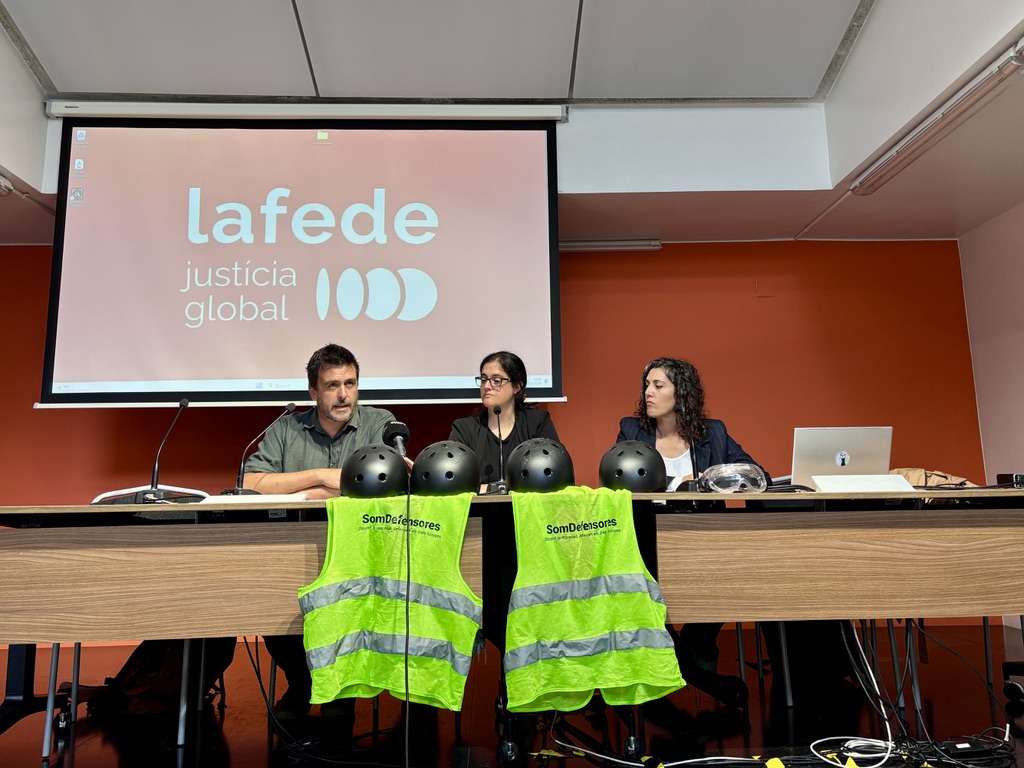
This morning, Som Defensores presented its observation and monitoring operation at Lafede to document potential human rights violations during the general strike on Wednesday 11 November. More than 60 people will take part. Between 35 and 40 observers will be on the streets, mainly in the Barcelona metropolitan area, organised into five teams in the morning and three in the afternoon, from 6.45 am until the end of the demonstrations.
A further 20 to 25 people will work from the coordination centre, where they will follow the teams, monitor social media and the press, and document potential violations across Catalonia.
Observers will wear fluorescent green vests bearing the Som Defensores logo, as well as identification badges. The operation has been formally notified to the Mossos d’Esquadra and will include human rights defenders from Italy and France.
The press conference featured Arés Perceval, co-president of Lafede; Anaïs Franquesa, director of Irídia; and Luca Gervasoni, director of Novact.
A strike with good reason
Arés Perceval explained that Lafede, which represents 137 organisations, is joining the general strike. “We are joining the strike, as are many organisations in the social sector, because we believe there are more than enough reasons to do so. Without housing or decent wages, there can be no global justice, either here or anywhere else,” she stated. “As a human rights federation, we find it incomprehensible that the Gag Law has not been repealed, and we will continue to defend the legitimate right to protest as a tool for collective pressure,” she added.
Protecting the right to strike
Anaïs Franquesa recalled that the right to strike is a fundamental right and that the police have the primary responsibility to protect it and facilitate its exercise. “A general strike is, by definition, a disruption of everyday life. Its very purpose is to block and bring the normal functioning of services to a halt as a form of protest,” she explained. She referred to the OSCE police manual, which establishes that such disruptions must be approached with a certain degree of tolerance, since an overly rigid approach can increase tensions.
Irídia has raised five main concerns:
- The use of pepper spray to disperse demonstrators. According to Irídia, the new protocol does not explicitly prohibit its use in cases of passive resistance. United Nations, OSCE and Amnesty International standards limit its use to situations involving defence against an imminent threat of harm.
- Police baton strikes.
- The use of police vehicles to disperse demonstrators, known as the “carousel” manoeuvre, a practice that has been used increasingly in recent times.
- Identity checks based on ethnic or racial profiling.
- Obstruction of the work of observers and media professionals.
“We call on the Mossos d’Esquadra to plan police operations in a way that limits the use of force as much as possible, as required by the precautionary principle. The use of force must always be the exception, never the rule,” Franquesa stated.
Observing to prevent
Luca Gervasoni explained that Som Defensores’ role is to observe, document and verify events independently and impartially. “Our presence serves three purposes: to prevent, document and protect. When people know they are being observed, abuses are less likely to occur,” he stated. “Documentation makes it possible to assess police actions, demand accountability and contribute to guarantees of non-repetition,” he added.
Gervasoni warned that civic space is shrinking across Europe and that the Gag Law remains in force. “A strike, by its very nature, disrupts normality. This disruption cannot, in itself, justify restrictions on fundamental rights,” he concluded.
How to ask for help
Anyone who witnesses or experiences a human rights violation can approach the observation teams, identified by their green vests. They will refer them to Irídia’s Service for Support and Reporting of Institutional Violence (SAIDAVI). SAIDAVI provides free legal and psychosocial support to people who experience police violence:
saidavi@iridia.cat or 693 287 323. In the event of arrests, people should contact anti-repression organisations.
Som Defensores will provide live updates throughout the day on X (@SomDefensores) and publish a public assessment once the strike has ended.
About Som Defensores:
Som Defensores is a human rights observation network led by Irídia, Novact and Lafede.cat, established in 2017 following the 1 October demonstrations. Since then, it has deployed observation teams during protest events to document and report human rights violations, particularly those related to police actions. Its most recent deployment took place during the strike for Palestine on 15 October 2025, which subsequently enabled it to report the use of pepper spray.