

Representatives of the three initiatives awarded the 2022 Nobel Peace Prize attend various institutional meetings
On January 29, 30, and 31, a delegation composed of the entities awarded the 2022 Nobel Peace Prize met with various Catalan and Spanish institutions to advocate for the role of civil society in promoting peace, justice, and democracy in the Eastern European region. The visit was organized by the Catalan International Institute for Peace (ICIP) and the Institute NOVACT of Nonviolence.

The Center for Civil Liberties (Ukraine), ICIP, and the Institute NOVACT of Nonviolence, in dialogue with the Memorial Human Rights Center (Russia) and the Viasna Human Rights Centre (Belarus), have reached a consensus on a document with seven proposals to strengthen the role of civil society and promote peace, human rights, and democracy in Ukraine, Russia, and Belarus. This advocacy document has been presented during various institutional meetings in Barcelona and Madrid.
The delegation was led by Oleksandra Romantsova, Executive Director of the Center for Civil Liberties (Ukraine); Natallia Satsunkevich, Member of the Interim Board of the Viasna Human Rights Centre (Belarus); Alexander Cherkasov, Chairman of the Board of the Memorial Human Rights Center (Russia); Kristian Herbolzheimer, Director of ICIP; Luca Gervasoni, Director of NOVACT; and Felip Daza, author of the report “Nonviolent Civil Resistance in Ukraine in the Face of War,” published by ICIP and NOVACT.
Luca Gervasoni, Director of NOVACT, states that the advocacy tour has allowed them to showcase the role that civil society plays in the region and the contributions it is making to promote human rights, justice, peace, and democracy. “Being able to showcase this work through the entities awarded the Nobel Peace Prize 2022 has helped institutions to give more value and relevance to the role of civil society as a driver and builder of peace,” he notes.
According to Kristian Herbolzheimer, Director of ICIP, “the aim of the delegation has been to complement the geopolitical perspective on the invasion of Ukraine with a human perspective, giving a voice to those who suffer from the aggression, as well as the repression of authoritarian regimes in Russia and Belarus.”
Among these seven recommendations, we find political, technical, and financial support for the international initiative “Special Tribunal against Russian Aggression,” support for human rights defenders and initiatives for the release of political prisoners in the region, as well as support for refugee and exile communities. Additionally, there is technical and diplomatic support for the Ukrainian government in developing public policies for community resilience.

Institutional Visits
On Monday, January 30th, in Barcelona, the delegation met at the Palau de la Generalitat with the President of the Government, Pere Aragonès, the Minister for Foreign Action and the European Union, Meritxell Serret, and the Minister for Justice, Rights, and Memory, Gemma Ubasart.
📸 El #president @perearagones i les #conselleres @MeritxellSerret i @gemmaubasart han rebut els representants de tres premi Nobel de la Pau 2022 d'Ucraïna, Rússia i Bielorrúsia al #Palau @exteriorscat @justiciacat pic.twitter.com/qyZ4pjsjLa
— Govern de Catalunya (@govern) January 30, 2023
At Barcelona City Hall, the delegation was received by the Deputy Mayor for Social Rights, Global Justice, Feminisms, and LGBTQI, Laura Pérez, and the Director of Global Justice and International Cooperation, David Llistar.
Ens reunim amb les entitats guardonades amb el Premi Nobel de la Pau per la seva defensa dels drets humans i el seu treball per resistir pacíficament a la guerra tant a Ucraïna, com a Rússia i Bielorússia. pic.twitter.com/BPXY6xKWm7
— Laura Pérez Castaño (@laurapcastano) January 30, 2023
After participating in the 1st Peace Conference of the Parliament of Catalonia, the delegation traveled to Madrid, where on Tuesday, January 31, they continued their agenda of institutional visits.
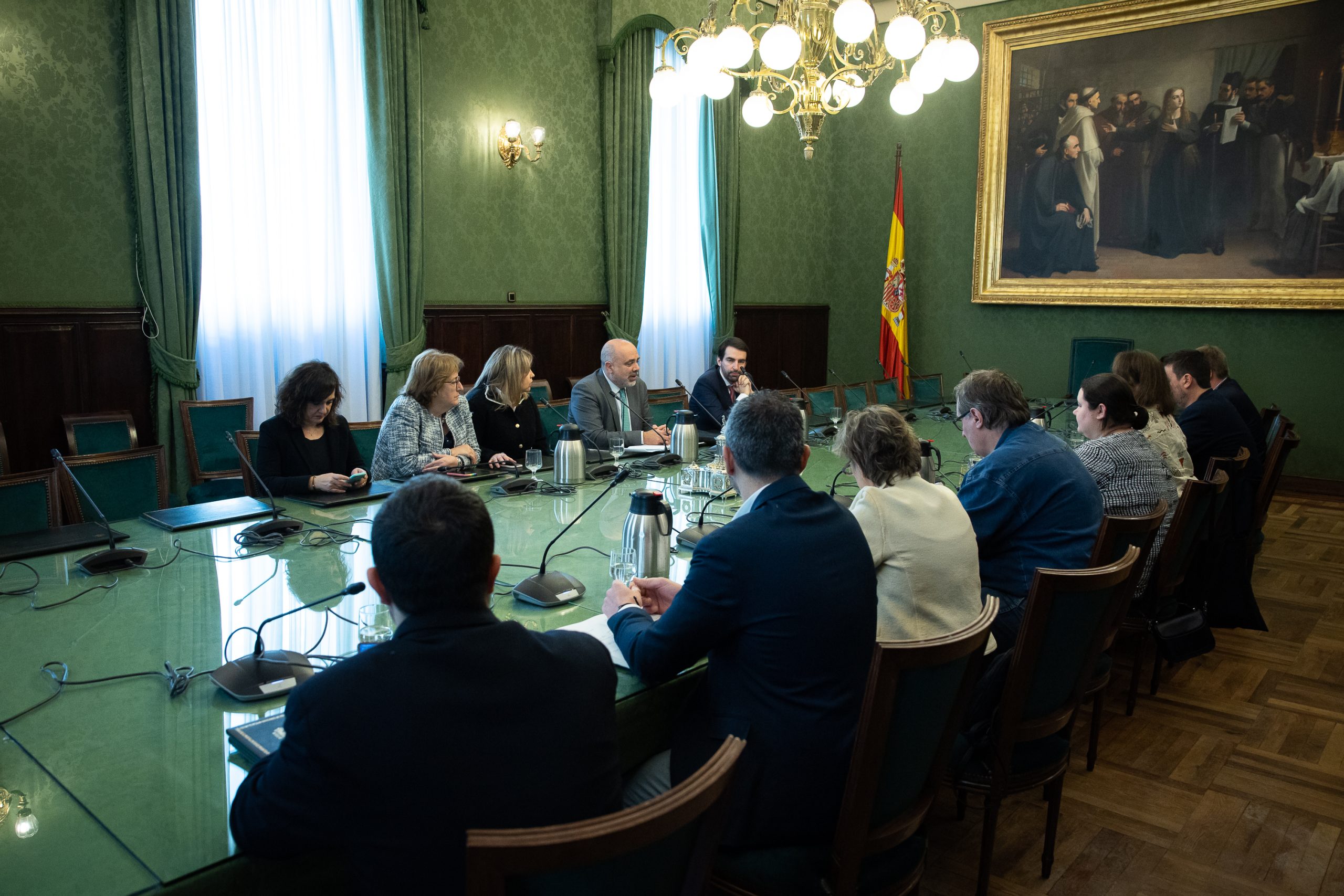
During the morning, they met with the Director of the Spanish Agency for International Development Cooperation, Anton Leis, and with the President of the Congress of Deputies, Meritxell Batet.
Later, they held meetings with the Foreign Affairs Committee of the Congress of Deputies, with its president Pau Marí Klose, and representatives from the PSOE, PP, and ERC; the Secretary of State for Foreign and Global Affairs, Ángeles Moreno Bau; and the Secretary General of the Administration of Justice, Antonio Dorado.
Public Meetings
It is also worth noting that the three organizations awarded the Nobel Peace Prize met on Sunday, January 29, at Lafede.cat (Barcelona) with around 30 people from the Ukrainian, Russian, and Belarusian diasporas in an unprecedented event, as it was the first time that the three diasporas had come together in the same space.
The tour concluded on Tuesday, January 31, with a press conference and a public event at La Casa Encendida in Madrid, titled ‘Peace Alternatives in the Face of the War in Ukraine,” attended by around 80 people. The event was organized by the Coordinator of NGOs for Development.